
Practical Life
The preliminary Practical Life exercises help the child to develop greater control and coordination of movement, concentration, orderly work habits, logical thought processes, and the ability to complete a cycle of activity from start to finish. As the child progresses in these areas, more complex exercises which require further concentration, control, and patience are introduced. The satisfaction derived from completing these purposeful tasks greatly increases the child’s self-esteem and physical independence and enables him or her to approach new challenges with confidence.


Sensorial
The Sensorial materials isolate abstract concepts, such as shape, colour, and size, in a concrete form, such as blocks, cubes, and cylinders. The child must discriminate differences and similarities in size, shape, colour, texture, and so on, by matching and grading these forms. Through continuous work with these materials the child becomes familiar with abstract concepts and refines his or her. sense perceptions. Many of the materials, such as the Pink Tower, Broad Stair, and Cylinder Blocks, are mathematically graded in units of 1-10, thus indirectly prepare the child for math. Games and extensions with familiar materials further refine the senses and encourage the child to relate the concepts learned to the greater environment.
The Geometry Cabinet introduces the child to basic geometry. Tracing these geometric shapes prepares the hand for the movements of writing and develops the muscular control necessary for handling a writing instrument. The games with the geometric shapes and cards help to familiarize the child with geometric shapes in a more abstract form and encourages the child to recognize these shapes by name. The Constructive Triangles are introduced after much work with the geometry cabinet. This material demonstrates the many geometric shapes which are formed with two or more triangles.
Language
The sound games help the child discriminate the sounds which comprise words. The sandpaper letters introduce the symbol for each of these sounds. Tracing the letters prepares the hand for writing and helps the child to relate the shape of the letter to the sound. When the child has become familiar with several sounds, we commence work with the Moveable Alphabet. The child uses moveable letters to construct words phonetically. Handwriting is introduced when the child has shown sufficient progress using the Metal Insets, which demand control of the writing instrument and lightness of touch.
Phonetic reading is introduced with the Phonetic Object Box. When the child has made progress in reading phonetic cards, we introduce the phonograms, which are two or more letters placed together to make one sound. The child makes words containing phonograms with the Small Moveable Alphabet Exercises which require the child to make words from memory help to improve spelling. Puzzle word cards introduce words with irregular spellings, and Word Study cards introduce prefixes, suffixes, compound words, and so on.

Math
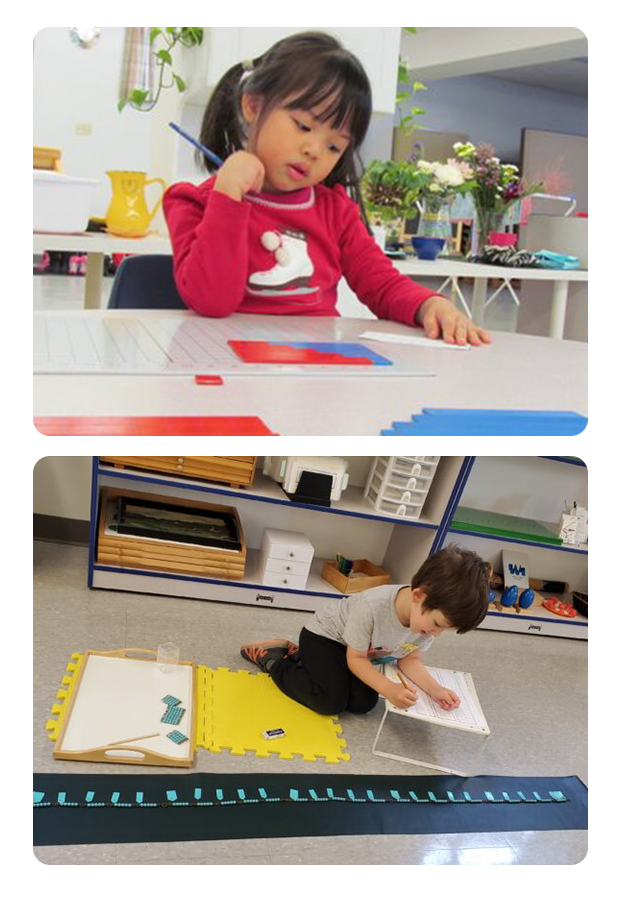
The child is prepared for math by working with the Sensorial Materials. The gradations of units 1-10 inherent in many of these materials, specifically in the Long Rods, familiarize the child with the relationship of numbers 1-10 before approaching them in an abstract sense. The math materials are sensorial materials in the form of rods, spindles, beads, or stamps, which have been given mathematical value. They provide the child with a concrete, sensorial impression of quantities and mathematical operations before they progress to abstraction. The Number Rods display the numbers 1-10 in concrete form, demonstrating that 10 is greater than 1, and that each number is a separate entity. When the child has learned the symbols 1-10, she or he matches the symbol to the quantity.
The Teen and Ten Boards require the child to once again match a quantity (beads)
with the written symbol.The Collective Exercises allow the children to participate together in carrying out mathematical operations using concrete materials (beads). These exercises provide the children with a concrete, sensorial impression of quantities and operations before they move on to abstraction.
The Stamp Game is a further step towards abstraction. The child carries out similar
operations to the Collectives, using smaller concrete representations of each category (stamps), and works independently.The Dot Game is demonstrated after the child has completed much work with the Stamp Game. The child counts dots instead of stamps, and the concept of carrying from one category to the next is introduced. This work prepares the child for work on a more abstract level.
The Snake Game is an exercise with which the child counts coloured beads of numbers 1-9 and becomes familiar with the combinations which add up to 10. The math charts are introduced when the child has mastered the former
exercises. This material allows the children to learn the addition, multiplication, subtraction, and division tables by working independently and checking their work with the charts.
Sensorial Materials and the Path to Abstraction
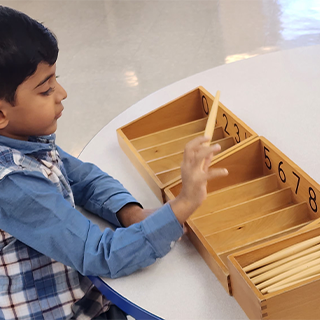
The Spindle Boxes
The Spindle Boxes require the child to count the appropriate number of spindles for each number. The child commences work with teens and tens, and the decimal system after successfully mastering the exercises which deal with numbers 1-10.

The Teen and Ten Boards
The Teen and Ten Boards require the child to once again match a quantity (beads) with the written symbol.

The Collective Exercises
The Collective Exercises allow the children to participate together in carrying out mathematical operations using concrete materials (beads). These exercises provide the children with a concrete, sensorial impression of quantities and operations before they move on to abstraction.

The Stamp Game
The Stamp Game is a further step towards abstraction. The child carries out similar operations to the Collectives, using smaller concrete representations of each category (stamps), and works independently.

The Dot Game
The Dot Game is demonstrated after the child has completed much work with the Stamp Game. The child counts dots instead of stamps, and the concept of carrying from one category to the next is introduced. This work prepares the child for work on a more abstract level.

The Snake Game
The Snake Game is an exercise with which the child counts coloured beads of numbers 1-9 and becomes familiar with the combinations which add up to 10.

The math charts
The math charts are introduced when the child has mastered the former exercises. This material allows the children to learn the addition, multiplication, subtraction, and division tables by working independently and checking their work with the charts.
French
French is an integral part of our program. Children are grouped by age and are introduced to the French Language through songs, phrases, descriptions, object identification and conversation.

Physical Geography
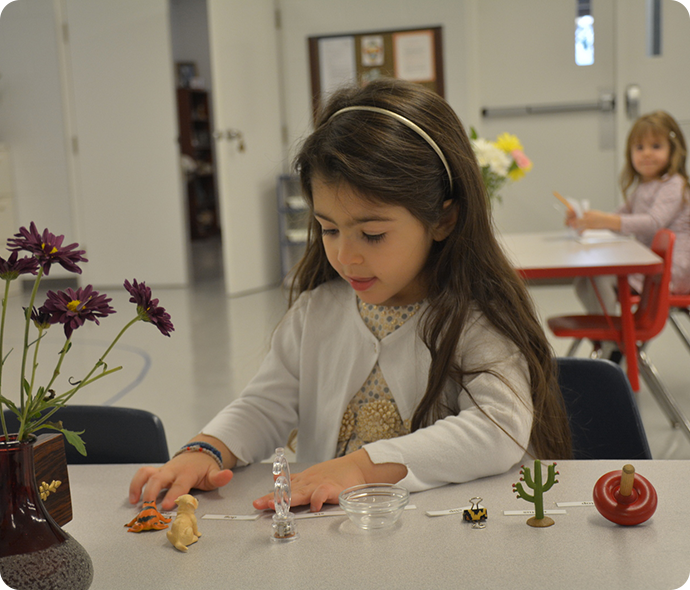
The large wood puzzle maps are among the most popular activities in the classroom. At first, the children use the maps simply as puzzles. Gradually, they learn the names of many of the countries as well as information about climate and products. The maps illustrate many geographical facts concretely. Children also learn the common land and water formations such as islands and peninsulas lakes and gulfs by making them.
Cultural Awareness Program
The children gain an awareness of the world around them by exploring other countries, their customs, food, music, climate, language, and animals. This helps to raise their consciousness about other people, to gain an understanding and tolerance, and, therefore, compassion for all the people in the world.

Science and Nature
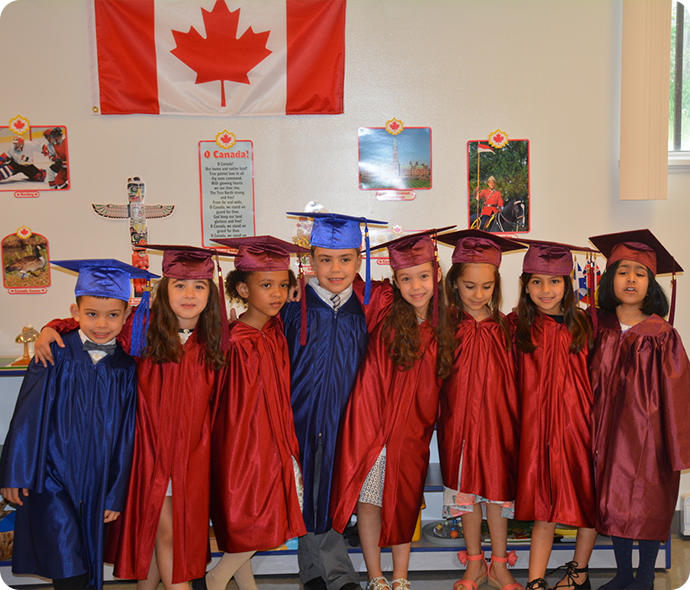
In science the children’s’ natural curiosity is stimulated through discovery projects and experiments, helping the children draw their own conclusions. The plant and animal kingdoms are studied in an orderly fashion to foster a love and appreciation for all living things.
Art & Music
The children participate in various art projects that reflect classroom themes, cultural celebrations and festive holidays. They are exposed to different art media, design, and techniques. The goal is to create an appreciation for self-expression and individuality.
The children have the freedom to explore their imaginations in a variety of mediums used for expression.
To enrich the music program Montessori designed a set of bells corresponding to the keys on the piano. Teachers are trained to use “The Bells” to teach the children the pitch of musical notes. This type of ear training early in life is excellent preparation for any further pursuit in music.
