
Dr. Maria Montessori
Who Was Dr. Maria Montessori?
Dr. Maria Montessori (1870-1952) was an Italian physician and anthropologist who devoted her life to understanding how children develop socially, intellectually, physically, and spiritually. By carefully observing children all over the world, she discovered universal patterns of development that are found in all children regardless of their culture or the era in which they live.
Dr. Montessori was one of the first women to be granted a diploma as a physician in Italy. Following her interest in human development, she assisted at a clinic for children with mental illnesses. She later directed the Orthophrenic School in Rome for children with physical, mental and emotional challenges. During this time, Dr. Montessori lectured throughout Europe concerning the needs of children and their value to the future of our societies. She stressed the need to change our attitudes about children and their treatment. In 1907, Dr. Montessori was given the responsibility of caring for a group of children in Rome’s San Lorenzo slum district. She began to see the importance of a positive, nurturing environment that changes with the developmental needs of the child. As she observed the children and their responses to the environment, she saw them demonstrate capabilities and interests that exceeded her expectations.
The set of materials used in the “Montessori” environment were designed over a period of many years by Dr. Maria Montessori and her associates, creating a concrete, physical representation of the concepts and skills that children are naturally motivated to learn in their normal course of development.
Dr. Montessori conducted her first international training course in Italy in 1913, and her first American training course in California in 1915. As she carried her vision around the world, she felt that a time had come to ensure the quality and integrity of what was being handed down in her training courses. For that reason, she founded the Association Montessori Internationale (AMI) in 1929. Today AMI continues to support quality teacher training worldwide.
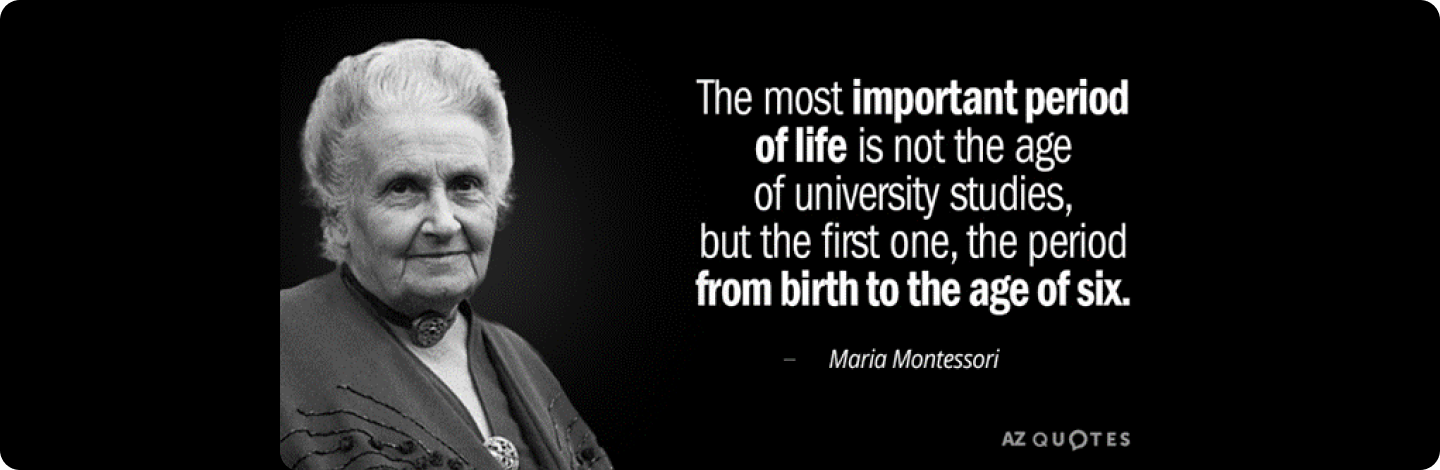
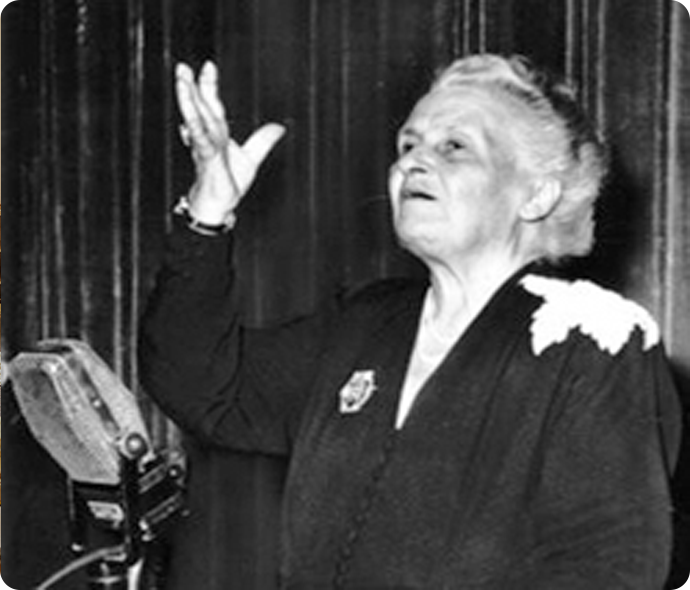
Maria Montessori was a visionary, not easily daunted by the many challenges she faced during her career. She traveled extensively, lecturing and teaching throughout Europe, India and in the United States. She was recognized for her efforts by educators, psychologists and political leaders of the day. Her associates included such people as Anna Freud, Erik Erikson, Mahatma Gandhi, Alexander Graham Bell and Jean Piaget.
Dr. Montessori was nominated for the Nobel Peace Prize in 1949, 1950 and 1951 and continued working, teaching and writing up to the time of her death. Over the past one hundred years children throughout the world have benefited from this educational approach that supports, nurtures, and protects natural development. Maria Montessori’s legacy lives on in the lives of the children whose lives are touched by her discoveries about life.
Renilde Montessori was Maria Montessori’s youngest grandchild. She lived and traveled with her grandmother as a child. After many years training teachers and furthering Montessori in Canada, in 1989 she founded the Foundation for Montessori Education, the AMI teacher training centre in Toronto, where she served as Director of Training until 1995. Though she traveled worldwide advocating on behalf of the child, she held a self-professed fondness for Canada. She was a personal friend and mentor to many of our staff at Golden Orchard Montessori School and was instrumental in the early development of our school.
In her own words
“My vision of the future is no longer of people taking exams and proceeding on that certification… but of individuals passing from one stage of independence to a higher, by means of their own activity, through their own effort of will, which constitutes the inner evolution of the individual.”
Introduction, From Childhood to Adolescence, Clio
“… The children themselves found a sentence that expressed this inner need. “Help me to do it by myself!” How eloquent is this paradoxical request! …It is in this that our conception differs both from that of the world in which the adult does everything for the child and from that of a passive environment in which the adult abandons the child to himself”
“I have served the spirits of those children, and they have fulfilled their development, and I kept them company in their experiences.”